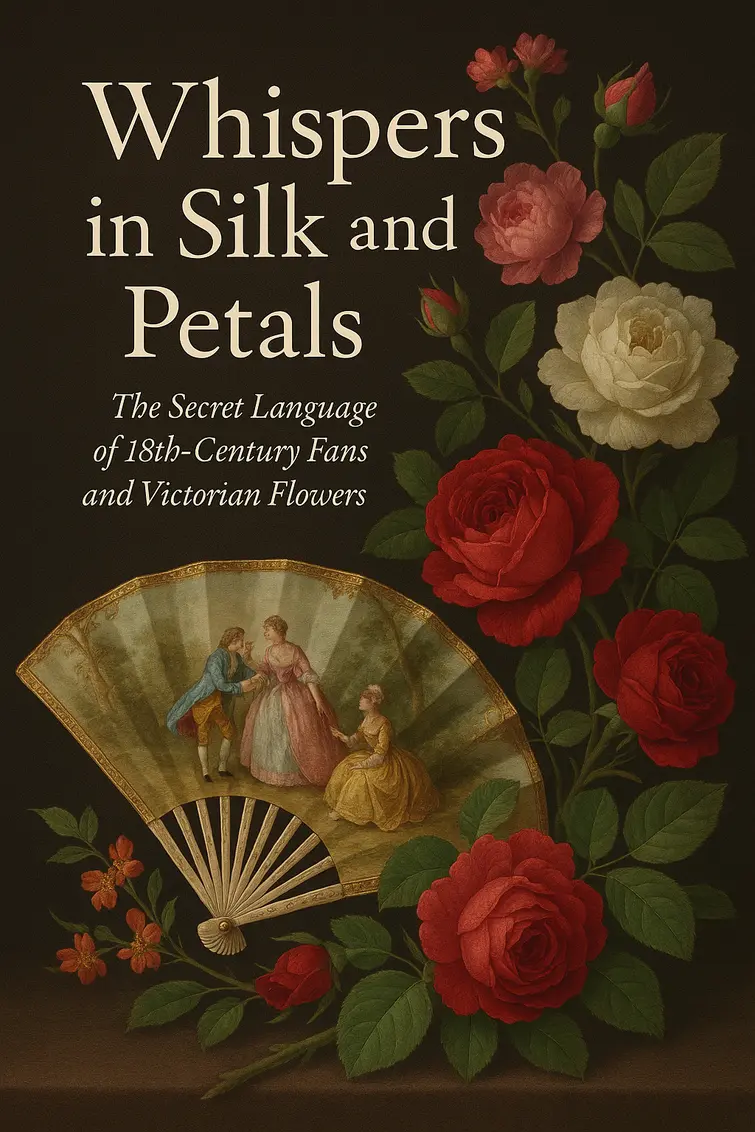
If you had a scandalous crush in 18th‑century London, you couldn’t simply send a flirty text or drop a heart emoji under their selfie. You had a chaperone on one side, a disapproving aunt on the other, and half the ballroom watching your every move. Yet, somehow, romances still blossomed, affairs still sparked, and hearts were broken with ruthless efficiency. How? Through the secret language of fans and the coded meanings of Victorian flowers.
In this article, we’ll explore how a folded ivory fan could confess forbidden desire, and how a seemingly innocent bouquet could be the polite equivalent of “it’s not you, it’s me.” We’ll step into glittering Georgian ballrooms and tightly laced Victorian parlours to decode the hidden messages that fluttered in the air and wilted in vases. This is the hidden world of silent communication, where love notes were written not in ink, but in silk, bone, and petals.
Our focus keyword for this journey is the secret language of 18th century British fans and Victorian flower meanings, a phrase that captures both the elegance and subversion of these historical codes. By the end, you’ll never look at a fan or a bouquet in quite the same way again.
The Hidden Architecture of Silence
To understand the secret language of 18th century British fans and Victorian flower meanings, we first need to picture the world in which they flourished. Imagine an 18th‑century London ballroom: chandeliers blazing with candlelight, musicians playing a sprightly country dance, silks and satins shimmering as couples turn in perfect patterns. It looks romantic, but beneath the glitter there’s a rigid social architecture holding everything in place.
Young women of good family were rarely left alone. They were chaperoned, escorted, and observed as if they were extremely valuable, extremely fragile, and potentially extremely troublesome objects. Their reputation was a kind of social currency, and one wrong move—a flirtation deemed too bold, a conversation too private—could devalue it overnight. A careless word might mean the loss of a good match, a broken engagement, or a lifetime of being whispered about behind fans.
Direct verbal communication, especially about romance or desire, could be a genuine social risk. A woman could not simply say, “I’m attracted to you” or “I’m not interested” without risking gossip. In such a world, the silence around desire wasn’t just awkward—it was enforced. If you couldn’t speak openly, you had to learn to speak in other ways.
This is where everyday objects turned into secret channels. The handheld fan and the carefully chosen bouquet became, in a very real sense, the encrypted hardware of clandestine romance. They were completely ordinary, completely acceptable, and therefore completely overlooked—until you knew how to read them.
From a modern perspective, this feels both stifling and ingenious. Repression pushed human creativity sideways. When words were dangerous, gestures became poetic. Ordinary things—an angle of the wrist, a cluster of primroses, a closed fan resting on a gloved hand—were loaded with meaning. Silence wasn’t empty; it was densely structured, like a code.
As we unpack the secret language of 18th century British fans and Victorian flower meanings, we’re really uncovering how people built entire emotional lives in the spaces where they were supposedly not allowed to have them.
Mastering the Fan Dialect: When Ivory and Silk Spoke Louder Than Words
Let’s start in the Georgian and early Regency period, where the folding fan was almost an extension of the body. Imported from Asia and then enthusiastically adopted by European society, fans in 18th‑century Britain were made from ivory, bone, mother‑of‑pearl, and painted papers or silks. They were gorgeous, yes—but they were also astonishingly useful for saying what you couldn’t say aloud.
There isn’t a single universal “dictionary” for fan signals—different manuals and sources offer slightly different codes—but by the late 18th and 19th centuries, several fan “languages” had been printed and spread across Europe. Whether or not every woman followed a strict manual, the idea itself tells us something important: people believed gestures could carry stable, shared meanings.
Broadly, fan language worked on three levels:
- Position – How open or closed the fan was
- Movement – The speed, direction, and style of motion
- Placement – Where the fan rested on the body or against clothing
Think of it as a tiny, portable semaphore system, except the message was usually closer to “meet me in the conservatory” than “enemy fleet approaching.”
Open, Half‑Open, Closed: The Mechanics of Meaning
One of the clearest aspects of the secret language of 18th century British fans was the distinction between a fan that was shut, half‑open, or fully open. Each state could imply a different emotional temperature—rather like setting your relationship status without anyone else noticing.
According to various 19th‑century “fanology” pamphlets (some sincere, some almost certainly tongue‑in‑cheek), certain gestures had fairly consistent meanings:
- Holding the fan closed – Often suggested disinterest or the end of conversation. It could signal, “I am not available,” literally and emotionally.
- Half‑opening the fan – A more ambiguous gesture, often interpreted as “we are being watched” or “proceed with caution.” It’s the historical equivalent of lowering your voice when the boss walks by.
- Fully opening the fan – Frequently associated with openness or acceptance. In some guides, it meant, “You may approach” or “Yes, I am receptive.”
These weren’t hard laws, of course, but flexible conventions. A young woman who was not supposed to seek out attention could, by the subtlest change in angle or openness, indicate whether a gentleman’s advances were welcome or not, without ever saying a word her aunt could overhear.
It’s tempting to imagine an entire ballroom where fans crack open like coded flowers, some half‑folded signals of caution, others thrown wide in a silent shout of “finally, he’s here.” The fan became a barometer of social and emotional weather—if you knew how to read it.
Across the Face and Through the Crowd: Fan Movements as Messages
If position was the grammar of the fan language, movement was its poetry. The way a fan moved could mean everything from “I love you” to “stop, we are being watched” to “you are annoying me beyond belief.”
Various 19th‑century codifications (many reprinted in modern popular history books) list signals such as:
- Fanning quickly – “I am engaged” or “I am already taken,” possibly because rapid fanning was associated with nervousness or agitation.
- Fanning slowly – “I am married.” In some guides, the slow, measured movement implied mature composure rather than girlish excitement.
- Carrying the fan in the right hand in front of the face – “Follow me.” A beckoning without a visible beckon.
- Touching the fan to the lips – “Kiss me,” or at least “I desire you,” depending on the source. Subtle? Perhaps not to the intended recipient.
- Letting the fan rest on the right cheek – “Yes.” On the left cheek, “No.” Conveniently untraceable in conversation.
- Passing the fan from hand to hand – “We are being watched,” a warning embedded in a seemingly idle motion.
Do we know with absolute certainty that every Georgian or Victorian woman knew and used these specific codes? Not necessarily. Historians debate how widespread and standardized fan language really was. Some argue that later “guides” may have romanticized or exaggerated the practice. But even if the formal systems were more playful than prescriptive, the core idea holds: the fan gave plausible deniability to flirtation.
What fascinates me is how these signals operated in what I’d call a double register. To the uninitiated—elderly relatives, clergymen, stern governesses—a lady was merely cooling herself decorously. To the man across the room, the same gesture might be a plea, a warning, or a promise. The same physical action occupied two realities at once, like a piece of social quantum physics.
Bypassing the Gatekeepers: Subversion in Plain Sight
The real genius of the secret language of 18th century British fans was not just that it allowed messages to be sent, but that it did so directly under the noses of those whose job it was to prevent such messages altogether. Mothers, aunts, and chaperones might position themselves strategically between their charges and potential suitors, but they couldn’t stop air from moving.
Fans turned obedience into camouflage. A well‑behaved young woman had to carry one in a crowded ballroom; anything else would have been considered odd. So the very symbol of feminine decorum became a vehicle for emotional and erotic expression.
This is subversion of the most quietly thrilling kind. Rather than openly rebelling, many women (and men) played the game better than the rule‑makers. They accepted the surface restrictions and then carved out tiny, almost invisible spaces of personal freedom inside them. Each flick of the fan, each half‑hidden glance through its pleats, was a small act of self‑assertion.
In a sense, the fan was technology: a device for encoding, transmitting, and decoding information in a hostile environment. Its users were early adopters of what we might now call “covert communication protocols.” Signals had to be brief, deniable, and understood only by the intended audience. In other words, it was the perfect communication tool for a world where privacy barely existed.
From Hands to Flowers: The Rise of Victorian Floriography
As the 18th century gave way to the 19th, Britain slid into the Victorian era: industrial, fast‑changing, and in many ways even more anxious about morality and propriety. Queen Victoria’s own famously sentimental and respectable image set the tone, and outward expressions of passion became, if anything, more constrained.
At the same time, another cultural fascination bloomed: an obsession with nature, gardens, and above all, flowers. Imperial trade opened Britain to an influx of exotic plants. Botanical gardens expanded, gardening manuals proliferated, and the domestic parlour filled with ferns and cut blooms. The Victorians didn’t just like flowers; they spoke with them.
This floral communication system, known as floriography, turned bouquets into coded texts. Each flower species—and often its colour, condition, and placement—carried a specific meaning. Books such as “Le Langage des Fleurs” (by Charlotte de Latour, 1819) and later English flower dictionaries helped popularise and standardise these symbolic associations across Europe and Britain. You can still explore many of these meanings via modern summaries, for instance on sites like the Victoria and Albert Museum website, which occasionally discusses Victorian symbolism.
The secret language of 18th century British fans and Victorian flower meanings thus forms a continuous tradition of non‑verbal romantic expression. Where the fan relied on gesture and movement, the bouquet relied on selection and arrangement. Both allowed people to turn ordinary objects into carriers of deep emotional content.
The Tussie‑Mussie: A Tiny Bouquet with a Big Mouth
One of the most charming vehicles for floral communication was the tussie‑mussie—a small, tightly packed nosegay of flowers and herbs, often worn or carried by a lady, or presented as a gift. Tussie‑mussies might be held in a little metal holder, sometimes made of silver, allowing the wearer to carry them decoratively at the waist or pinned to a bodice.
On the surface, they were simply pretty, fragrant accessories, ideal for brightening a sooty London winter or softening the less appealing aromas of a pre‑deodorant world. But beneath the petals, they could hold paragraph‑length secrets.
Each component might contribute a word or phrase to the message. For example:
- Red rose – Deep love, passionate affection
- Primrose – Young love, or in some cases, “I can’t live without you”
- Yellow carnation – Rejection, disappointment, or “You have disappointed me”
- Fennel – Flattery or strength
- Ivy – Fidelity, attachment, dependability
- Lavender – Devotion, luck, or remembrance
By combining these elements, a sender could compose a miniature letter: a declaration, a complaint, a request for forgiveness. Some guides insisted that even the order and density of the flowers mattered, creating subtle shades of meaning that only fellow enthusiasts would fully grasp.
To modern eyes, this might seem hopelessly indirect. Why not simply write a note? But remember: letters could be intercepted. Servants might gossip. Siblings might snoop. A bouquet, on the other hand, was innocuous—unless you knew, for instance, that a yellow carnation hidden among white roses was essentially the 19th‑century equivalent of a passive‑aggressive text.
Red Roses, Yellow Carnations, Wilted Primroses: When Flowers Became Sentences
Among Victorian flowers, a few became celebrities in their own right, thanks to their strong symbolic associations. Understanding these is key to grasping Victorian flower meanings as a whole.
Red rose: Hardly a surprise, the red rose was the undisputed heavyweight champion of love symbolism. It usually meant passionate, romantic love. A single red rose could scream “I adore you” far louder than any sonnet—particularly in a time when public declarations were frowned upon.
Primrose: More delicate and wistful than the rose, the primrose often symbolised young love, early love, or the tender beginning of affection. In some guides, sending primroses meant “I can’t live without you.” But condition mattered. A wilted primrose could suggest fading love, lost innocence, or a love that had been damaged. Imagine receiving a slightly drooping tussie‑mussie of primroses from someone you had just snubbed at a dance—an eloquent floral sigh.
Yellow carnation: If red roses were “I love you,” yellow carnations were “we need to talk.” In many dictionaries, they signified disappointment or even contempt. Slipping a yellow carnation into an otherwise neutral bouquet was like adding a barbed comment into a polite conversation. You could present flowers with a smile and yet deliver a quiet, cutting rebuke.
This is where the question, “What if a simple bouquet of primroses was actually a devastating breakup text?” stops sounding fanciful and starts sounding plausible. Depending on their choice of blossoms, Victorians could signal:
- Devotion (ivy, myrtle, red roses)
- Jealousy (yellow rose, often associated with envy or infidelity)
- Refusal (striped carnation, interpreted by some as “no” or “I cannot be with you”)
- Friendship only (pink roses, in some readings)
- Mourning or sorrow (weeping willow motifs, cypress, certain dark blooms)
Senders could even correct or soften their own earlier messages. Follow up a harsh yellow carnation with a bouquet heavy on forgiveness‑coded blossoms, and you effectively texted, “I may have overreacted; can we start again?”—but all in petals.
Placement Matters: Where You Wore the Message
Just as the positioning of the fan modified its message, the placement of a bouquet or tussie‑mussie could tweak or intensify Victorian flower meanings. Though conventions varied, some patterns emerge from period accounts and etiquette discussions.
For example:
- Worn over the heart – A sign that the message was deeply felt. A tussie‑mussie pinned close to the bodice suggested the wearer accepted or reciprocated the feelings expressed in the arrangement.
- Carried in the right hand – Sometimes interpreted as acceptance or favour.
- Carried in the left hand – Could hint at reluctance, doubt, or refusal.
- Placed on a table and turned away – A gentle but firm rejection. The flowers were received, but their message was symbolically set aside.
This layering of meaning—choice of flowers, arrangement, condition, and placement—meant that Victorian bouquets weren’t just pretty accessories; they were multi‑dimensional emotional diagrams. Every decision was loaded. Even the act of not wearing the flowers you had been given might send its own, painfully clear message.
Trying to reconstruct these codes in modern terms, I’m struck by how much social energy was poured into learning and maintaining these shared symbolic systems. It required memory, attention to detail, and a willingness to play along. In a world with fewer open conversations, people didn’t necessarily feel less; they simply felt through more complicated channels.
When Codes Collided: Miscommunications and Social Scandals
Of course, any system of coded communication is only as good as its users’ shared understanding. If you’ve ever misread a text that was meant as a joke, you already understand how floriography could go horribly, publicly wrong.
Flower dictionaries weren’t fully standardised. One handbook might list the camellia as “admiration,” another as “perfected loveliness.” A particular shade of rose might mean “secret love” in one guide and “friendship” in another. It was all too easy for a well‑meant bouquet to be interpreted as an insult, or for a carefully coded refusal to be taken as encouragement.
There are scattered anecdotal reports—some in 19th‑century periodicals, others in memoirs—of such misunderstandings leading to embarrassment or even scandal. Imagine:
- A gentleman sends a lady what he believes is a subtle bouquet of admiration and respect. She consults a different flower book and concludes he’s hinting at marriage. Her family begins to make plans.
- A woman designs a tussie‑mussie meant to say, “I forgive you, but we must remain only friends.” The gentleman, using an alternative dictionary, sees only symbols of faithful, enduring love and assumes he’s back in her favour.
- A bored socialite deliberately exploits the ambiguities, sending a bouquet that can be read either as devotion or disdain, depending on which meanings one prefers. When questioned, she simply shrugs and points to a more innocuous flower guide.
Some historians suspect that part of the thrill of the secret language of 18th century British fans and Victorian flower meanings lay precisely in this instability. Codes that can be bent can also be plausibly denied. A lady caught out might say, quite truthfully, that in her flower dictionary, that yellow bloom symbolised joy, not disappointment.
This suggests a deeper truth about human communication in tightly controlled societies: people often cultivate ambiguity as a survival strategy. By speaking in symbols, they preserve both their desires and their reputations. The risk, of course, is that they may also lose control of how their messages are received.
Tools of Subversion: The Psychology of Silent Rebellion
What was it like to live inside this world of fans and flowers—where certain movements or arrangements could make your pulse race or your stomach drop? I suspect it was intoxicating.
There’s a particular psychological thrill in having a private channel of meaning running beneath the polite surface of society. In a Victorian drawing room, a woman might sit calmly embroidering while across the space, a friend slowly opens a fan or adjusts a bouquet, and a whole separate conversation unfolds between them, invisible to everyone else.
For those constrained by gender, class, or reputation, this kind of symbolic subversion offered at least three consolations:
- Agency – A controlled gesture could communicate consent, refusal, warning, or encouragement. Women, who were often presumed to be passive, could in fact direct the flow of interaction with remarkable subtlety.
- Safety – If confronted, a fan flick or a flower choice could be dismissed as meaningless. The line between code and coincidence stayed pleasantly blurred.
- Intimacy – Sharing a code created a sense of closeness. If two people both knew that a particular gesture or blossom meant “I am thinking of you,” they inhabited a little shared world inside the larger, more hostile one.
It’s also telling that much of this coded behaviour took place in highly ritualised, almost theatrical settings: the ball, the promenade, the parlour visit. These were public stages where everyone played a part. By slipping secret gestures and floral messages into these performances, people effectively wrote their own subplots.
We often caricature Georgians and Victorians as prudish or emotionally constipated. The secret language of 18th century British fans and Victorian flower meanings tells a more interesting story. It suggests that desire didn’t disappear; it learned to move sideways, through objects, glances, and scents. Repression didn’t kill romance—it forced it to become more inventive.
Modern Echoes: From Fan Flicks to Soft Launches and Emojis
Before we congratulate ourselves on living in a more straightforward age, it’s worth asking how much we really differ from our fan‑flicking, flower‑wielding ancestors. In some ways, we’re surprisingly similar; we’ve simply swapped ivory and petals for pixels and notifications.
Consider how we communicate attraction, interest, or rejection today:
- Soft launches on social media – Posting a partial photo of a partner, a second coffee cup, or a vague holiday shot. Not an outright announcement, but a hint meant for those “in the know.”
- Emojis – A heart, a flame, or even a carefully chosen flower emoji can radically change the meaning of a message. Add a single 🙃 to a sentence and the tone shifts entirely.
- Online status signals – The double blue tick, the “typing…” bubble, the “last seen” time stamp. We read these digital gestures as signs of interest, avoidance, or preoccupation.
- Playlist sharing – Sending someone a song or playlist that “just made me think of you” is essentially sending a modern tussie‑mussie of musical meanings.
All of these operate as tiny codes layered beneath ordinary communication. Outwardly, it’s just a message, a story, a song. To the intended recipient, it may say, “I miss you,” “I’ve moved on,” or “I’m not ready to talk.”
The parallels with the secret language of 18th century British fans and Victorian flower meanings are striking. In both cases:
- The signals are often deniable (“Oh, that was just a song I liked,” “I was only fanning myself, it was hot in there”).
- The full meaning depends on context and shared understanding.
- The codes flourish most intensely in situations where people feel watched or judged—by family, by colleagues, by followers, by the algorithm.
Humans, it seems, are endlessly inventive when it comes to carving out private spaces within public, heavily surveilled environments. Whether it’s a Victorian girl in a crinoline under her aunt’s eye, or a teenager whose parents follow them on every platform, the impulse is the same: to create layers of meaning that feel like they belong only to you and your chosen few.
Why These Secret Languages Still Matter
So why should we care about the secret language of 18th century British fans and Victorian flower meanings now, beyond the sheer romantic charm of it all?
First, these codes remind us that history is rarely as simple as it looks from the outside. A stiff family portrait or polite letter might suggest a life of pure restraint and duty. But underneath, people were flirting, rebelling, longing, and negotiating their desires just as intricately as we do now—only with a different toolkit.
Second, these systems reveal how culture can shape not only what we are allowed to say, but how we learn to feel. When love, anger, or disappointment are expressed through bouquets or fan gestures, those emotions are experienced through ritual and symbol. We may even speculate that having such highly codified channels could intensify feelings, packing each gesture with significance.
Third, these historical codes invite us to reflect on our own habits. When we agonise over whether to like someone’s post, whether to send a second text, or whether a certain emoji is too forward, we are essentially composing a 21st‑century equivalent of a tussie‑mussie. We are still, in our own way, arranging digital flowers.
Finally, there’s something quietly hopeful in the fact that repression so often births creativity. When straightforward paths are blocked, humans don’t simply give up; they find side roads and secret tunnels. Fans became ciphers, flowers became sentences, and an entire hidden language grew beneath the surface of polite society.
Conclusion: Listening to the Whispers of Fans and Flowers
The secret language of 18th century British fans and Victorian flower meanings is more than an amusing historical curiosity. It’s a window into how people navigated love, desire, and social control in eras obsessed with appearances and morality. A closed fan could guard a reputation; an open one could invite a stolen moment. A red rose declared passion; a yellow carnation quietly ended hopes. A wilted primrose might have said more about loss and disappointment than a dozen carefully crafted letters.
By decoding these silent dialects, we uncover a world where women and men negotiated their feelings with remarkable subtlety, using objects that were considered trivial or purely decorative. Fans and flowers became powerful tools of social subversion, enabling personal agency in spaces where direct speech was dangerous.
In many ways, their strategies are not so different from ours. Today, our secret languages are built from likes, stories, statuses, and symbols on screens. But the impulse behind them—the longing to carve out private meaning in public spaces—remains the same.
So next time you catch yourself overthinking an emoji, or notice the bouquet someone chose with suspicious care, remember the Georgian lady at the edge of the ballroom, half‑opening her fan, and the Victorian lover composing a tussie‑mussie with trembling hands. Across centuries, we are all still learning to speak where we are not supposed to, finding ways to say, “I see you, I choose you, I refuse you, I forgive you,” with whatever tools our age provides.
In silk, in ivory, in petals, and now in pixels, the conversation continues.