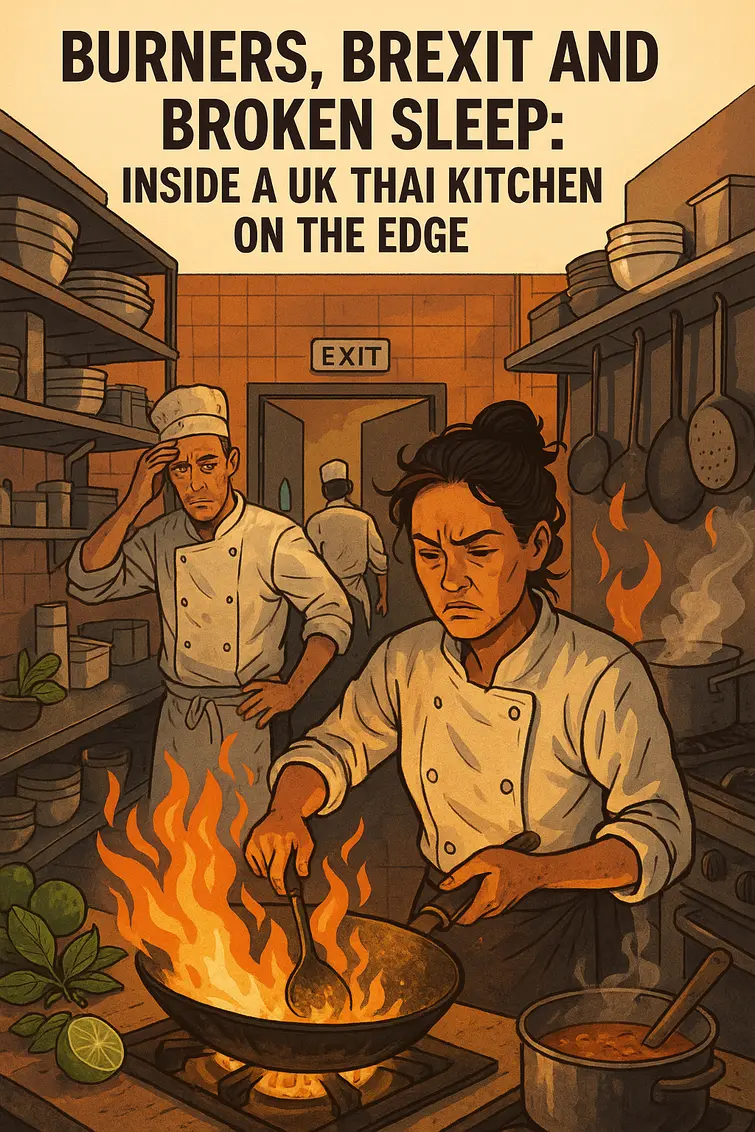
Step through the swinging door of a busy UK Thai kitchen in 2026 and you won’t just find the comforting crackle of woks and the perfume of lime leaves and basil. You’ll find frayed tempers, missing chefs, handwritten rota changes and the constant, bone-deep fear that tonight might be the night it all finally falls apart.
This is the hidden reality of a post-Brexit Thai restaurant in Britain, where labour shortages have transformed dinner service into a nightly endurance test. The tickets keep printing. The burners never go out. But the people behind the pass are running out of steam.
In this blog, we’ll step into that heat – literally and metaphorically – and explore how a modern UK Thai kitchen is fighting to survive. We’ll look at the emotional toll, the technical chaos, the historical background of Britain’s hospitality trade, and the strange way politics, immigration and a fragrant green curry have become tangled together.
Our focus keyword for this journey is UK Thai kitchen post-Brexit labour shortages – because this is more than a restaurant story. It’s a story about a country, its changing identity, and the human cost of political decisions that eventually turn up on your dinner plate.
The Heat Behind the Hatch: A Night in a UK Thai Kitchen
Imagine walking into a small but busy Thai restaurant in a British city – maybe London, Manchester, or a seaside town that’s become surprisingly obsessed with pad thai. The dining room is warm and full of chatter. Candlelight flickers against patterned wallpaper. The soundtrack is relaxed, perhaps a bit of lo-fi mixed with Thai pop. Everything, from the outside, looks calm.
Now push through the kitchen door. On the other side is a different universe: steel, steam and controlled panic. The first thing you feel is the heat – a blast of air from the roaring burners, wok flames licking high every few seconds. The second thing you feel is the pace. Everybody is moving, fast. Nobody is standing still. The printer at the pass spits out fresh orders like an impatient demon.
Before Brexit, this UK Thai kitchen had a full brigade: head chef, sous-chef, separate wok and grill stations, a curry specialist, two prep chefs, plus pot-wash and a runner. After Brexit, tightened immigration rules and the departure of many EU and non-EU workers left gaping holes. Half the team are gone. The work hasn’t shrunk. The menu hasn’t shrunk. Only the people have.
That’s how you end up with one chef trying to work three stations at once. One person frying chicken wings, tossing noodle dishes in a smoking-hot wok, and keeping an eye on a pot of coconut curry threatening to split. This is what UK Thai kitchen post-Brexit labour shortages look like from the inside: frantic multitasking as a default state of existence.
“I’m at My Breaking Point”: The Emotional Cost of Endless Service
We often romanticise kitchens as places of passion – the fiery chef, the art on the plate, the glamour of the restaurant world. But when staffing collapses, that passion can curdle into something darker. The emotional toll of a UK Thai kitchen in this post-Brexit reality is intense, and often invisible.
Imagine finishing a twelve-hour shift and realising you’ve eaten nothing but a few chips, a stray prawn and six gulps of fizzy drink. Your hands are shaking from adrenaline and low blood sugar. You can still hear the echo of the ticket printer in your head. You know you have to get up tomorrow and do it all again – with exactly the same number of missing staff.
For many chefs and kitchen workers, the conversation is shifting from, “This is hard work” to, “This is damaging my mental health.” That moment of confession – “I’m at my breaking point” – is becoming tragically common. It’s not a dramatic exaggeration for the sake of social media. It’s the quiet truth of people who no longer know how to cope.
Some of the recurring emotional pressures in a UK Thai kitchen post-Brexit include:
- Chronic exhaustion: Constant overtime, split shifts and no reliable end time to the working day.
- Guilt: Feeling responsible for every delayed table or imperfect dish, even when the system itself is broken.
- Invisible anxiety: Smiling at front-of-house staff while quietly panicking about a broken fridge, a sick colleague, and the ninth 10-top of the night.
- Isolation: Friends outside hospitality rarely understand the hours, the pressure, or why you can’t just “take a break.”
When we talk about UK Thai kitchen post-Brexit labour shortages, we are not just talking about recruitment statistics. We are talking about human beings being stretched to their emotional and psychological limits in order to keep serving food that looks serene and beautiful when it lands on your table.
Six Mains on the Pass, Two Chefs Missing: Technical Chaos in Real Time
Emotion is one side of the story. The other is pure logistics. Running a professional Thai kitchen is a technical ballet of timings, temperatures and teamwork. Remove key dancers from that ballet and the choreography explodes.
Picture this snapshot of a typical service in a UK Thai kitchen:
- Six mains are up on the pass, all needing to leave within the next three minutes.
- Two chefs who would normally handle starters and salads have left the country and their roles remain unfilled.
- A third chef is out sick, leaving only three people on the line instead of six.
- The waiting time has crept up to forty-five minutes – and the customers are beginning to complain.
In a pre-Brexit world, an experienced team could adjust, borrow a person from another branch, call in an agency chef or draft in a part-timer at short notice. In a post-Brexit environment, with rigid visa requirements and a shrunken labour pool, there is often no one left to call. The remaining staff have to absorb everything.
That’s when culinary precision turns into survival mode. A UK Thai kitchen post-Brexit labour shortages scenario often features a series of hard compromises:
- Woks run slightly cooler to avoid burning dishes when the chef’s attention is divided.
- Garnishes get simplified – one herb instead of three, a quick scatter of spring onion instead of a carefully constructed salad.
- Stock pots are stretched further, sometimes at the expense of depth of flavour.
- Chefs cut corners not because they are lazy, but because they are human beings with only two hands.
Is it still good food? Often, yes. Many Thai kitchens are masters at maintaining flavour even under pressure. But this constant firefighting comes with a long-term cost: lost craft, lost pride, and the nagging fear that one night, a mistake will slip through that they can’t fix with extra chilli and a smile.
How Did We Get Here? A Brief History of UK Hospitality and Migration
To understand why a UK Thai kitchen post-Brexit feels like this, it helps to zoom out and look at the bigger historical picture. Britain’s restaurant scene has always been entangled with migration. From the curry houses founded by South Asian seafarers in the 19th century to the explosion of Chinese, Italian and Caribbean food in the post-war era, Britain’s appetite for international cuisine has relied on international workers.
Thai kitchens are part of that story. Many Thai restaurants in Britain were founded by first-generation immigrants who wanted to share their food culture – or simply survive in a new place through the one skill they could always carry: cooking. Their staff often included:
- Thai nationals on hospitality visas.
- EU workers with freedom of movement, ready to learn new cuisines.
- British-born staff trained up in-house over time.
Brexit did not instantly erase all of this, but it reshaped the playing field. Freedom of movement ended. Visa rules tightened. The bureaucratic cost of sponsoring skilled workers increased. Combined with the pandemic, many EU nationals left, and a portion of older workers simply decided not to return to the stress of hospitality.
In short, the ecosystem that once supported a thriving Thai restaurant scene became brittle. A UK Thai kitchen post-Brexit labour shortages crisis wasn’t created overnight, but it was accelerated by policy choices that treated workers as numbers rather than as irreplaceable parts of a living culture.
The True Cost of Your Curry in 2026
From the dining room, you see only the final flourish: the glossy red of a panang curry, the neat mound of jasmine rice, the artful drizzle of coconut cream. What you don’t see is the chef who came in early to prep lemongrass, the line cook who skipped their break to batter chicken, or the manager who stayed late to do the rota because no one else is available.
The phrase “the true cost of your curry” isn’t about guilt-tripping diners. It’s about connecting the dots between the political headlines and the bowl of food in front of you. In a UK Thai kitchen post-Brexit labour shortages world, that bowl may carry with it:
- Higher prices: Restaurants are forced to raise menu prices to cover increased wages, visa sponsorship fees and recruitment costs.
- Reduced menus: Many Thai restaurants quietly cut the number of dishes they offer because they simply don’t have the manpower to prep everything traditionally.
- Longer waits: When there are fewer skilled hands, cooking times inevitably increase, especially at peak hours.
- Shorter opening hours: Some venues now close two or three days a week to protect staff from burnout – or because there’s nobody left to work.
Yet there’s another cost that rarely makes the spreadsheets: cultural erosion. When you can no longer afford to train staff properly, when you simplify recipes to make them manageable for a skeleton team, parts of the cuisine itself begin to fade. That careful homemade curry paste gets replaced with a bought-in version. The labour-intensive, regional specials vanish from the menu. The food becomes less rooted in tradition, more about survival.
Holistic Wellness in a Hellishly Hot Kitchen
Given this backdrop, the idea of “wellness” in a UK Thai kitchen might sound like a dark joke. Yet more and more chefs and owners are realising that if they don’t address the wellbeing of their staff, there simply won’t be a restaurant left to run.
Holistic wellness isn’t just smoothies and yoga. In the context of UK Thai kitchen post-Brexit labour shortages, it can look like:
- Real breaks: Insisting that even on the busiest nights, staff sit down for ten minutes to drink water and eat something.
- Mental health check-ins: Managers asking, “How are you really doing?” and meaning it – and being willing to adjust shifts when someone is at breaking point.
- Boundaries: Not messaging staff at midnight about rota changes, and refusing to normalise seventy-hour weeks as a badge of honour.
- Training for resilience: Teaching staff basic breathing exercises, stretching routines, and simple stress-management techniques they can actually use on the line.
Some forward-thinking Thai restaurants in the UK are experimenting with proactive wellness measures: offering staff counselling resources, scheduling regular days when the whole team eats together after service, or even closing for one week a year to reset. These may seem like luxuries in a tight-margin industry, but in the long run, they may be the only way to keep the people – and therefore the culture – intact.
Thai Tradition Meets British Grit: Cultural Fusion Under Pressure
One of the most fascinating (and bittersweet) aspects of the UK Thai kitchen post-Brexit labour shortages story is the way two cultures collide and cooperate under strain. Thai kitchens often rely on deeply embedded values: respect for elders, discipline, quiet determination, and a belief in the almost sacred role of food in bringing people together.
British hospitality, on the other hand, brings its own cultural flavours: humour in the face of disaster, a tendency to moan while still turning up for the shift, the famous “Keep Calm and Carry On” mentality (even if everyone is secretly not calm at all).
In the heat of the kitchen, these traits blend into a unique survival cocktail. You might see:
- An exhausted British commis chef learning the Thai word “ใจเย็น” (jai yen – “keep a cool heart”) as a mantra for surviving a busy Friday.
- A Thai head chef adopting a very British style of dark humour, declaring, “If we get through tonight, I’m starting a monastery” while plating salads at triple speed.
- Shared staff meals where green curry and chips co-exist happily in the same bowl, a small symbol of cultural fusion forged under pressure.
In a strange way, hardship is strengthening the bonds inside many UK Thai kitchens. When there are fewer of you, you either turn on each other or you become a kind of temporary family. Many are choosing the second option, even though it means sharing not only jokes and snacks, but also the heavy emotional load of simply keeping the doors open.
Urban Secrets: What You Don’t See Walking Past a Thai Restaurant
Every British city and many small towns now hide these stories in plain sight. You walk past a glowing shopfront that smells of chilli and lemongrass; you see cheerful diners clinking glasses; perhaps you pop in for a quick takeaway. You don’t see the rota pinned up in the staff corridor with three shifts covered in red ink because there’s nobody to work them.
The secret life of a UK Thai kitchen post-Brexit labour shortages world includes scenes like:
- A manager quietly washing dishes after close because the pot-wash had to leave early for childcare.
- A chef spending their day off at a visa office, clutching folders of documents, hoping their colleague’s work permit is approved.
- Two staff members sleeping on the night train back from a trial shift in another city, because there are so few experienced Thai chefs left that they’re shared like rare resources.
It’s tempting to think that as customers, we are outside this drama – that it belongs to “the industry.” But in truth, we shape it. Every discount demanded, every aggressive review over a slightly longer wait time, every assumption that hospitality work is “unskilled” contributes to the pressure cooker.
Conversely, small acts of kindness from diners – patience when told there’s a delay, a sincere compliment passed to the kitchen, a generous tip when you know the restaurant is understaffed – can make an outsized difference. They don’t solve the structural problems of a UK Thai kitchen post-Brexit, but they do remind the people working inside it that someone sees them.
Can UK Thai Kitchens Survive This Era?
This is the uncomfortable question hovering over the sizzling pans: how many UK Thai kitchens can survive the combined weight of post-Brexit labour shortages, rising costs and staff burnout? Some already haven’t. Quiet closures, especially in smaller towns, rarely make the news, but locals notice when their favourite neighbourhood Thai suddenly goes dark.
Yet there is also a surprisingly stubborn streak of hope in this story. Restaurant people are notorious for their resilience. Many owners and chefs are actively reimagining what a healthy, sustainable Thai restaurant could look like in modern Britain:
- Slimmer, smarter menus: Focusing on fewer dishes done exceptionally well, rather than sprawling menus that demand huge prep teams.
- Hybrid service models: Mixing dine-in with takeaway, delivery and meal-kits that allow some prep to happen in calmer, off-peak hours.
- Better pay and progression: Trying, within tight budgets, to make hospitality a long-term career rather than a stop-gap job.
- Community roots: Building strong local followings so that even when times are tough, regulars keep the place afloat.
Policy change would help – easier routes for skilled hospitality workers, recognition that a Thai chef is not “unskilled” just because their artistry involves a wok rather than a white tablecloth. Organisations like UKHospitality (https://www.ukhospitality.org.uk) have been lobbying on these issues, highlighting the impact of Brexit on staffing.
But while we wait for politics to catch up, individual Thai kitchens are innovating on the ground. Every streamlined prep list, every rota that protects a chef from burnout, every conversation about mental health in the staff room is, in its own way, a small act of resistance.
What We Can Learn from the Wok Station: Wider Cultural Lessons
Beneath the specific drama of a UK Thai kitchen post-Brexit labour shortages lies a set of broader questions about the kind of society Britain wants to be. A country’s restaurant culture often mirrors its values more honestly than its official speeches.
From the chaos and courage of these Thai kitchens, we can draw a few sobering – and oddly inspiring – lessons:
- Interdependence is real: You can’t enjoy global cuisine while closing your doors to global workers without consequences. Food exposes that contradiction very quickly.
- Invisible labour holds everything up: The person chopping coriander stems in the back corner might be the single point of failure between a great service and a meltdown.
- Wellbeing is infrastructure, not a luxury: You can’t build a sustainable food culture on burnout. Eventually, the cracks show on the plate.
- Cultural exchange is fragile: If we don’t support the people who carry these culinary traditions, we risk losing them – or flattening them into something less authentic, less alive.
There’s also something quietly magical about the way, even under pressure, these kitchens keep producing bowls of comfort and joy. It speaks to an ancient truth that Thai culture understands very well: food is more than calories. It’s story, memory, medicine and connection all at once.
How Diners Can Support a UK Thai Kitchen Post-Brexit
Watching this struggle from the outside, it’s easy to feel powerless. But ordinary diners do have influence, even if it’s small-scale and local. Some practical ways to support your favourite UK Thai kitchen in the post-Brexit era include:
- Be patient with delays: If the restaurant is transparent about being short-staffed, accept that good food may take a little longer.
- Avoid no-shows: If you can’t make a booking, cancel it. Empty tables on a fully staffed night are financially brutal.
- Order direct: When possible, order from the restaurant’s own website or phone line rather than high-fee delivery apps.
- Tip fairly: Tips can make a real difference to overworked staff who may not be seeing the full value of their labour in their base pay.
- Spread the word: Leave thoughtful, honest positive reviews when you have a good experience. Loyal customer bases act like a safety net in turbulent times.
None of these actions fix structural issues on their own, but collectively they help create a softer landing for restaurants balancing the realities of a UK Thai kitchen post-Brexit labour shortages landscape.
Conclusion: Keeping the Burners Lit Without Burning Out
Behind every fragrant bowl of tom yum and every perfectly charred pad kra pao in Britain lies an unseen story: a story of missing staff, extra shifts, late-night stress and early-morning prep. A story of cultural pride doing hand-to-hand combat with political policy. A story of people who love food enough to keep cooking even when the system seems designed to exhaust them.
The UK Thai kitchen post-Brexit labour shortages crisis is not just a hospitality issue. It’s a mirror reflecting how this country treats those who feed it, how we value mental health and cultural diversity, and how connected we are willing to remain to the wider world.
If there is hope here – and there is – it lies in the stubborn refusal of these kitchens to give up. It lies in the owners experimenting with new business models, in chefs finally talking openly about burnout, in diners choosing to be allies rather than critics when service is under strain.
Next time you sit down in a Thai restaurant in the UK and a steaming curry arrives at your table, take a moment. Behind that plate is a whole ecosystem of history, labour, sacrifice and skill. Appreciating that – and supporting it however you can – might be the most meaningful way to say, “ขอบคุณครับ / ค่ะ” (thank you) to the people keeping the burners lit in a very uncertain age.