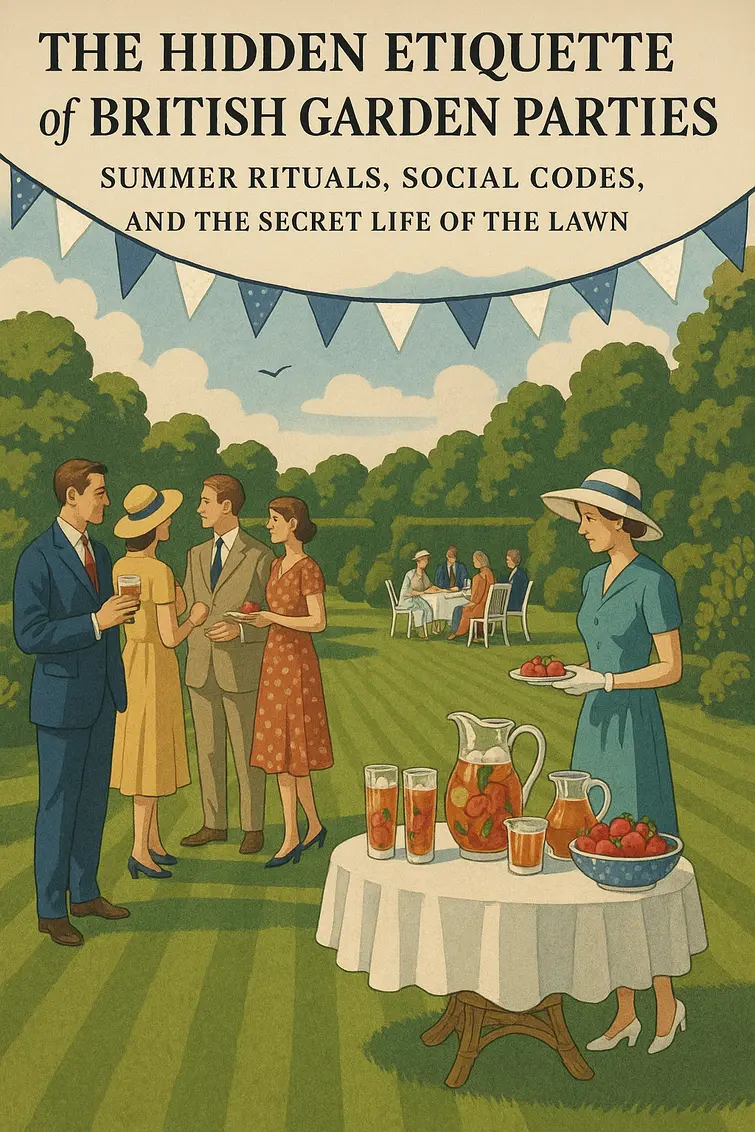
There is something beautifully strange about a British garden party. On the surface, it is all sunshine, strawberries, and politely wilting bunting. Yet beneath the clink of ice in Pimm’s and the rustle of linen lies an invisible rulebook. In this secret text, a misplaced teaspoon is a diplomatic incident, the angle of a cucumber sandwich is a coded message, and the timing of the first drink can make or break your social standing.
This hidden etiquette of British garden parties did not appear overnight. It is part tradition, part theatre, part social survival strategy forged over centuries of outdoor entertaining in unpredictable weather. From aristocratic lawns in the 18th century to suburban patios in 2026, the garden has been a stage on which Britain quietly rehearses its anxieties about class, manners, and what it means to be a good host.
In this guide, we will wander across the lawn together. We will decode the costume of summer, the liquid protocol of drinks, the precise architecture of sandwiches, the choreography of conversation, and the subtle art of leaving at exactly the right time. Whether you are planning your first British garden party or nervously attending one, this exploration will help you navigate the hidden etiquette of British garden parties with grace, humour, and just enough insider knowledge to keep you from committing social ruin.
Think of this not only as a practical manual, but as a cultural and historical journey: how a simple afternoon outside became a mirror of British society, its rituals, its snobberies, and its secret hopes that no one sees us sweat—literally or socially.
The Curious History Behind British Garden Parties
Before we examine the modern hidden etiquette of British garden parties, it helps to know where all this ritual came from. After all, nobody wakes up one morning and decides that crustless cucumber sandwiches are socially non-negotiable without a story behind it.
Garden parties have their roots in several overlapping traditions:
- Aristocratic country-house weekends in the 18th and 19th centuries
- Royal garden parties at Buckingham Palace in the Victorian era
- The rise of afternoon tea as a social institution
- The suburban boom of the 20th century, with lawns as new stages of respectability
In grand estates, gardens were performance spaces. Hosts did not simply grow roses; they grew reputations. Guests were invited to stroll, to see and be seen, and to demonstrate they understood the invisible rules of behaviour. When Queen Victoria began hosting formal garden parties, that aristocratic ritual filtered down in softened, more accessible form to the middle classes.
Afternoon tea—originally a small, private snack between meals—soon escaped into the garden. By the early 20th century, the idea of tea on the lawn, complete with delicate sandwiches, fine china, and structured socialising, had become a marker of correct behaviour. Even today, the hidden etiquette of British garden parties borrows directly from these older rituals: who pours, who speaks first, who sits, who serves, and who watches.
Seen this way, every garden party is a little historical re-enactment. The linen suits, the cautious small talk, the careful timing of drinks—these are not random choices. They are echoes of centuries spent turning the lawn into a social laboratory.
The Costume of Summer: Dressing for the Lawn’s Unspoken Rules
The first test of the hidden etiquette of British garden parties begins before you even leave the house: what to wear. The British summer dress code is a paradox. You must look relaxed, but not careless. Elegant, but not ostentatious. Breezy, but prepared for a sudden downpour and a temperature drop of five degrees.
This is not just fashion; it is social signalling. The garden is the runway on which the unspoken hierarchy of linen, cotton, and carefully chosen footwear is displayed.
Here are some of the key elements:
- The “effortless” outfit that took you an hour to plan – You want to look as if you simply threw it on. The truth is, coordination of colours, textures, and practicality is a strategic operation.
- The silent ranking of fabrics – At a certain level of formality, linen speaks of relaxed confidence, seersucker whispers old-school charm, and a well-cut cotton dress or shirt suggests you respect both the host and the weather.
- The white shirt as social armour – In 2026, the crisp white shirt has become a kind of unisex shield. It says: “I know the rules. I am playing the game.” You can dress it up or down, but it always signals control.
The hidden etiquette of British garden parties demands that you also think about the journey from patio to lawn. Shoes that look perfect on stone suddenly sink like tragic sculptures into grass. The truly seasoned guest anticipates this.
Some practical strategies include:
- For women: Block heels, wedges, or elegant flats instead of stilettos that risk becoming lawn anchors.
- For men: Loafers, brogues, or smarter trainers for casual affairs. Anything too glossy or formal looks strange against grass.
- Everyone: Avoid wearing anything you would be devastated to stain with grass, strawberries, or an overly enthusiastic Pimm’s.
Personally, I find this element of the hidden etiquette fascinating because it reveals how much we care about the illusion of ease. The more complicated the preparation, the more desperately we want others to believe that we are simply “naturally” well put together. In that sense, the costume of summer becomes a form of quiet magic: you conjure an image of effortless belonging while your wardrobe tells another story entirely.
The Liquid Protocol: The Dangerous Art of the Pimm’s Pour
If the outfit is your social armour, the drinks are the invisible script. Nowhere is the hidden etiquette of British garden parties more intricate than in the timing and management of the first Pimm’s pour.
Pimm’s, with its floating fruit and herbs, is not just a drink. It is a ritual. Pour it too early, and you look overeager. Pour it too late, and guests begin to suspect this “relaxed afternoon” might actually be a dry run of monastic life.
So what is the correct moment? Traditionally, it falls into a pattern:
- Arrival window: Guests arrive, remove coats (if the weather allows), and receive a soft welcome—often sparkling water, elderflower cordial, or a very light wine.
- Once the core group is present: The host announces or quietly initiates the Pimm’s. This usually happens once about two-thirds of guests have arrived.
- Before food, not after dessert: Pimm’s is a pre-food and with-food drink, not a late-evening digestif.
Serving Pimm’s immediately on arrival can be seen as slightly heavy-handed, as if the host is nervous and wants to lubricate conversation too quickly. Waiting until guests are visibly parched also sends a message: you misjudged the tempo.
Beyond timing, the hidden etiquette of British garden parties extends to how you manage your glass. There is a subtle art to this:
- Hold the glass by the stem or lower half – This avoids warming the drink and signals quiet familiarity with social occasions.
- Never slosh or gesticulate wildly – A garden party is not a tavern. Spilling on the lawn is forgivable; spilling on another guest’s linen is not.
- Accepting top-ups gracefully – It is perfectly correct to say “Just a splash, thank you” or “I’ll switch to water in a moment.” Moderation is part of the code.
Hydration plays an unglamorous but vital role in this hidden etiquette. Between the sunshine, the alcohol, and the polite pressure to say “yes” to just one more glass, it is surprisingly easy to drift from charming to incoherent. Experienced hosts weave water into the ritual:
- Carafes of water on tables, with cucumber, mint, or citrus
- Quiet encouragement: “Shall I refresh your water?” alongside drink offers
- A shift to tea or coffee in the late afternoon, marking a slow-down in alcohol service
In many ways, the liquid protocol mirrors broader British anxieties about control and pleasure. The hidden etiquette of British garden parties tries to balance gentle hedonism with restraint: you may enjoy yourself, but elegantly, and preferably without falling into the herbaceous border.
The Sandwich Architecture: Geometry, Status, and Crumbs
It may sound absurd, but the cucumber sandwich is one of the great symbols of the hidden etiquette of British garden parties. This humble triangle, crustless and delicate, carries within it layer upon layer of history, class, and silent judgement.
Why such obsession with shape and structure? Because food at a garden party is not just nourishment; it is part of the performance. The correct architecture of your sandwich signals that you understand the deeper script of the lawn.
A classic cucumber sandwich follows certain unwritten rules:
- Crusts removed – This tradition comes from refined tea service and remains non-negotiable at more formal events. Crusts signal everyday food; crustless triangles signal occasion.
- Thin, even slices of cucumber – Thick slices make the sandwich clumsy and liable to collapse mid-conversation, an existential threat to white linen.
- Delicate size – These sandwiches should be eaten in two or three bites, never more. Garden party food should never demand physical struggle.
- Triangle or clean rectangle – Geometry matters. Odd shapes or ragged edges hint at haste or inexperience.
Beyond cucumber, the hidden etiquette of British garden parties applies to the whole buffet. At a “bring-a-dish” event, there is a quiet competition between guests, but also an unwritten law: you must not overshadow the host.
To navigate this correctly:
- Aim for complement, not dominance – If the host is known for spectacular desserts, bring a beautiful salad or savoury dish instead.
- Present your dish in a shareable way – Pre-sliced, bite-sized, or easily portioned food shows respect for the flow of the party.
- Avoid anything too messy – Foods that drip, explode, or crumble dramatically are the mortal enemies of summer outfits and polished social calm.
Then there is the art of the “standing eat”: the ability to hold a plate, a drink, and a conversation, all while ensuring not a single crumb hits the grass. The hidden etiquette of British garden parties expects a sort of quiet mastery here.
A few survival techniques include:
- Limit yourself to food you can comfortably eat with one hand or a fork.
- Balance your plate on your fingertips, not your palm, to keep it level.
- Take smaller bites; nothing should require a jaw-dislocating effort.
- Consciously face away from other guests when tackling more delicate mouthfuls.
To an outsider, this may seem comically overthought. But the more you observe, the clearer it becomes: the hidden etiquette of British garden parties is obsessed with making everything look smooth on the surface, even if it requires immense behind-the-scenes calculation with sandwiches and napkins.
The Choreography of Conversation: Weather, Wit, and Escape Routes
Perhaps the most mystical part of the hidden etiquette of British garden parties lies in conversation. British social life is famously powered by small talk, but at a garden party, that small talk takes on almost ritual significance.
It often begins with the weather, but not because Britons lack imagination. The weather is a safe arena in which guests test each other’s conversational style. It is a social vetting process masquerading as harmless chat.
A classic opening might be:
- “We’ve been lucky with the weather today, haven’t we?”
- “I brought an umbrella just in case—this is Britain after all.”
- “I checked three different weather apps. None of them predicted this sunshine.”
From here, the conversation can flow in several directions: gardening, travel, work (lightly), local events, or shared acquaintances. What matters is tone. The hidden etiquette of British garden parties favours:
- Light, inclusive topics – Anyone nearby should be able to join in without feeling excluded.
- Moderate self-deprecation – A gentle poke at one’s own lack of gardening skills, for example, is socially charming.
- Curiosity without interrogation – Asking questions is good; drilling people like a customs official is not.
Equally important are the forbidden topics that threaten the delicate equilibrium. Generally avoided are:
- Intense political arguments
- Deeply personal questions about money, relationships, or health
- Highly controversial social issues (unless you are sure of your company)
- Heavy complaints that drag the mood down
Modern Britain is changing, of course, and some garden parties are intentionally more open, radical, or experimental. But as a rule, the hidden etiquette of British garden parties still treats the afternoon lawn as a space for temporary harmony—a gentle pause from the world’s worst arguments.
One of the more subtle skills you will need is the graceful exit from stagnant conversations. The “beverage refill” manoeuvre is a classic escape hatch. It works like this:
- Wait for a natural pause.
- Smile warmly and say something like, “I’m just going to top up my drink—can I get you anything?”
- Whether or not they accept, you now have a reason to move away, politely and without insult.
There is a kindness in this choreography. Rather than abrupt endings, the hidden etiquette of British garden parties prefers exits that allow both parties to save face. Everyone understands the code; nobody names it out loud.
The Subtle Dance of Seating and Standing
At many garden parties, people drift between chairs, blankets, benches, and standing clusters. This movement is not random. The hidden etiquette of British garden parties quietly shapes where you sit, when you stand, and how you integrate newly arrived guests.
Hosts usually create zones:
- A central social area – Near the food and drinks, where guests naturally gather.
- Quieter corners – For more in-depth conversations or those who need a break from the crowd.
- Child-friendly or pet-friendly spaces – Slightly more chaotic, but joyfully so.
As a guest, you can read the social map with a little observation.
- Standing with a drink near the centre usually signals openness to new conversations.
- Sitting on the edge of the group, especially with fewer people around you, suggests a desire for calmer interaction.
- Pulling a chair into a tight circle is more intimate—fine with friends, less so with strangers.
It is also courteous to adjust your position as new guests arrive. Making space, pulling in another chair, or shifting slightly to open a gap in the circle are all quiet ways of saying, “You are welcome here.” The hidden etiquette of British garden parties is full of such unspoken invitations.
Personally, this is my favourite part of the ritual, because it reveals a gentler side of British social life. Even amidst all the rules and subtle hierarchies, there is a sincere wish—however awkwardly expressed—to include others, to prevent anyone from feeling like a stray figure at the edge of someone else’s perfect day.
The Art of the Exit: When and How to Leave the Lawn
If arrival is the opening scene of the play, departure is the final act—and it is surprisingly easy to get it wrong. The hidden etiquette of British garden parties draws a fine line between leaving too early and overstaying your welcome.
Three types of guests exist in lore:
- The Phantom – Leaves so early and so quietly that people later ask, “Did they ever actually come?”
- The Timed Performer – Arrives neither first nor last, leaves after a respectable stay, and exits gracefully.
- The Sticky Guest – Is still there while the host is stacking chairs and silently planning their next party without them.
As a general rule, staying for around two to four hours is considered ideal for most garden parties, unless the host explicitly invites you to linger longer. Watch for signals:
- Food is cleared away.
- Drinks slow down or switch to tea and coffee.
- Chairs start migrating indoors.
- The host glances frequently at the time or mentions an early start tomorrow.
Then there is the question of how to leave. The hidden etiquette of British garden parties recognises two main types of exit: the formal goodbye and the discreet slip (sometimes jokingly called the “French leave”).
Formal goodbye is usually preferred for smaller or more intimate events:
- Find the host, thank them specifically: mention the food, atmosphere, or something you genuinely enjoyed.
- Say a brief goodbye to those you have spent the most time with, without creating a dramatic farewell scene.
- Avoid long, emotional conversations at the exit point; this congests the social doorway.
The “French leave” is more acceptable at large, bustling gatherings where the host is busy or difficult to locate. You may simply slip away after making sure you have not left belongings behind. In this case, the hidden etiquette expects a follow-up message later.
This follow-up is not just courtesy—it is part of the social spell that ensures you will be invited again. A thoughtfully worded message might:
- Thank the host warmly.
- Mention something specific and personal, such as “Your rose garden was beautiful” or “That lemon cake was unforgettable.”
- Express a gentle hope to see them again, without sounding demanding.
These small flourishes allow the garden party to echo into the future. In a sense, the party continues in memory and future invitations, and the hidden etiquette of British garden parties exists precisely to protect this continuity.
Modern Twists: Inclusivity, Climate, and Evolving Rituals
Of course, the hidden etiquette of British garden parties is not frozen in time. As Britain itself changes, so do the rituals of the lawn. Today’s garden gatherings must navigate new realities: dietary diversity, climate awareness, and shifting social norms.
Some of the ways the tradition is evolving include:
- Inclusive menus – Vegetarian, vegan, gluten-free, and allergy-aware options are no longer afterthoughts but essential elements of considerate hosting.
- Alcohol-free options – Thoughtfully prepared mocktails and non-alcoholic Pimm’s-style drinks respect guests who choose not to drink.
- Eco-conscious hosting – Reusable glasses, real plates, and cloth napkins are favoured over disposable plastics, reflecting a greener ethic.
At the same time, the British climate is forcing subtle changes. Heatwaves, sudden storms, and shifting seasons mean that garden parties now involve more contingency plans:
- Gazebos and parasols for shade as well as rain.
- Earlier start times to avoid the harshest afternoon sun.
- Fans or misting sprays discreetly tucked into corners on very hot days.
Interestingly, as the world becomes more informal in some ways, the appeal of structured, gentle rituals grows. Many younger hosts are rediscovering the charm of traditional etiquette—not as a tool of exclusion, but as a form of intentional, thoughtful hospitality. The hidden etiquette of British garden parties can, in this light, become an art of care rather than of snobbery.
My own view is that the healthiest modern garden party keeps what is kind and humane from the old codes—respect for guests, attention to comfort, beauty in the small details—and lets go of the parts that were merely about hierarchy. A well-timed Pimm’s, a forgiving dress code, and a willingness to welcome those who do not know all the rules: that is the future of the lawn.
Practical Checklist: How to Survive (and Enjoy) the Hidden Etiquette
To bring together everything we have explored about the hidden etiquette of British garden parties, here is a simple, practical checklist for hosts and guests.
For guests:
- Choose an outfit that is comfortable, breathable, and lawn-friendly.
- Opt for shoes that will not sink into grass.
- Arrive within the suggested time window (not dramatically early, not fashionably hours late).
- Accept the first drink graciously, but pace yourself and intersperse water.
- When in doubt, begin with weather small talk and move gently to other topics.
- Avoid heavy or divisive subjects unless the group clearly welcomes them.
- Eat in a way that is neat and manageable; avoid balancing heroic towers of food on a tiny plate.
- Leave somewhere between two and four hours in, unless the mood obviously suggests otherwise.
- Thank your host in person and, ideally, follow up later with a short message.
For hosts:
- Set a clear dress code tone through the invitation (e.g., “smart casual,” “summer chic”).
- Plan the first drinks so they appear at the right moment, not rushed or delayed.
- Offer plenty of non-alcoholic options and lots of water.
- Create a food spread that is easy to eat while standing and that caters to different dietary needs.
- Arrange seating in clusters that encourage conversation but allow movement.
- Circulate among guests, gently connecting those who might enjoy meeting.
- Have a light plan for shelter in case of rain or strong sun.
- Signal the winding down by gradually clearing food and transitioning to tea or coffee.
- Receive goodbyes with warmth, not guilt—your guests are part of the ritual too.
In the end, the hidden etiquette of British garden parties is less about perfection and more about consideration. At its best, it is a shared spell everyone weaves together so that, for a few hours on a patch of lawn, the world feels gentle, ordered, and kind.
Conclusion: Reading the Lawn Like a Secret Map
We have wandered through the secret world of the lawn—from the high-stakes choreography of teaspoons and Pimm’s pours to the quiet hierarchy of linen shirts and the angle of cucumber sandwiches. We have seen how the hidden etiquette of British garden parties is really a tapestry woven from history, class, humour, insecurity, and a deep national love of ritualised relaxation.
By now, you should be able to read a garden party like a silent script:
- The costume of summer, where “effortless” is anything but.
- The liquid protocol, where the first Pimm’s pour is an act of social timing.
- The sandwich architecture, where geometry and crumbs matter more than we admit.
- The choreography of conversation, with its weather-oracle opening lines and gentle exits.
- The art of the exit, where timing and follow-up messages decide whether you are invited back.
Yet beneath all the rules and rituals lies something very human. The hidden etiquette of British garden parties is ultimately about care: not embarrassing each other, not staining each other’s clothes, not dragging each other into conflict on what is meant to be a light, sunlit afternoon. It is a collective agreement to make things smoother than life usually allows.
So the next time you step onto a British lawn in summer, take a breath. Notice the linen, the glasses, the sandwiches, the way people stand and drift and laugh about the weather. You are not just at a party; you are stepping into a living tradition, a quietly magical piece of cultural theatre. And now that you know the hidden etiquette of British garden parties, you can play your part with confidence, grace, and just enough mischief to keep it interesting.