From Washing Plates to Paying Taxes: The Cost of UK Business Ownership
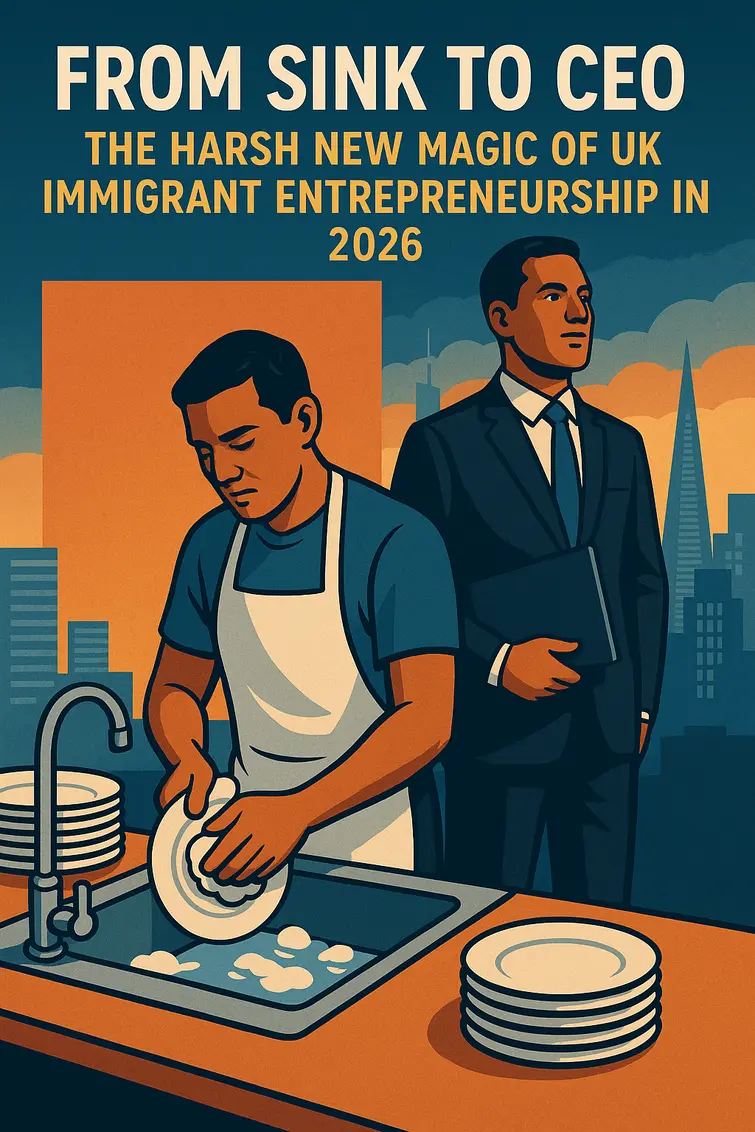
Once upon a time in Britain, the story was simple and almost mythic: you arrived with a suitcase, found a job washing dishes, worked every shift offered, saved every pound… and one day your name appeared above the door of your very own café, takeaway, or restaurant. That journey from washing plates to paying taxes as a proud business owner felt like a modern folk tale of grit, luck, and late nights.
But in 2026, that tale is mutating into something far darker and more complicated. The numbers no longer match the legend. Overheads roar, staff vanish, delivery apps circle like hungry dragons, and the dream of UK business ownership – especially in hospitality – is turning into a riddle very few can solve.
In this article, we’ll explore how the path from kitchen porter to proprietor has changed, why the old ladder of upward mobility is splintering, and what new, sometimes strange, blueprints immigrant entrepreneurs are using to survive. Along the way, we’ll treat the British high street as both a historical stage and a living mystery: a place where economics, culture, and ambition collide in unpredictable ways.
Our focus keyword in this journey is UK business ownership. We’ll look at the past, dissect the present, and sketch a realistic – if slightly magical – map of where things might go next.
The Old Legend: From Washing Plates to Owning the Shop
Before we talk about the current crisis in UK business ownership, we need to remember the classic script that shaped so many lives, especially for immigrants arriving in the 1980s, 1990s and early 2000s.
In the 1990s, the rough path went something like this: you started at the bottom, usually in hospitality – washing dishes, clearing tables, doing whatever was needed. But that first job wasn’t just about money, it was an entry ticket. You watched how the front-of-house worked, how suppliers delivered, how cash moved, how regulars were treated. The kitchen sink was a classroom.
The magic of that era was that the economic environment, while far from easy, allowed mistakes. Rents were lower, energy was cheaper, food costs were more predictable, and labour was easier to find. If you saved enough, borrowed a bit from friends or family, maybe took out a modest loan, you could rent a small unit and start something of your own. If you messed up the first time, there was still some room to try again.
Most importantly, there was a sense of a ladder: an informal but very real pathway from entry-level work to partial management, then to partnership, then to owning the place – or opening your own. It wasn’t guaranteed, but it felt possible enough to fuel millions of dreams.
The False Promise of the Ladder in 2026
Fast forward to 2026, and the old story of UK business ownership is cracking. The ladder still exists in people’s minds, but the rungs have shifted, and some have quietly disappeared.
Many immigrant workers are still told the same story: start at the sink, work hard, learn the ropes, and one day this place – or a place like it – can be yours. But when you look at the economic reality, that promise now often functions more like a comforting myth than a reliable plan.
Three big shifts have warped that once-familiar ladder:
- The collapse of middle management: In many independent hospitality businesses, there’s no longer a thick middle layer of assistant managers or junior partners. There’s the owner, a handful of supervisors, and everyone else. That crucial midpoint – where you gained responsibility and maybe a share of profits – has thinned out or vanished entirely.
- Statistical improbability: The leap from minimum-wage worker to equity holder has become rare, not just because of bias or bad luck, but because the economics simply don’t produce enough profitable small businesses to share ownership of.
- Debt as punishment, not a springboard: In the 1990s, taking on modest debt to start a small café could, with luck, be cleared in a few years. In 2026, the same risk can lock you into a financial trap with rising interest, unpredictable costs, and far narrower margins.
The dream hasn’t died, but the price of admission has risen while the odds of success have shrunk. The old narrative, borrowed from the American Dream style of upward mobility, is now clashing with a harsher British reality: survival first, ambition second – if at all.
The Invisible Ceiling of Overhead: The New Boss of the High Street
If the old ladder has become unreliable, one of the main culprits is what we might call the “invisible ceiling” of overhead. In 2026, UK business ownership feels less like climbing a staircase and more like pushing against a glass dome of fixed costs that refuse to budge.
Owners in hospitality now face a brutal “triple threat” of overheads that together can crush even the most hardworking entrepreneur:
- Energy price volatility: Gas and electricity, once a manageable line item, now behave like trickster gods, dancing up and down with little warning. For a restaurant where ovens, fridges, and extractor fans run constantly, a sudden spike can erase months of profit.
- Post-Brexit labour levies and complexities: The cost – financial and administrative – of hiring the staff you need has risen. Visa rules, sponsorship obligations, and limited access to EU workers haven’t just shrunk the labour pool; they’ve made every hiring decision riskier and more expensive.
- Skyrocketing cost of raw ingredients: Food supply chains have become more fragile, and price increases are passed down the line to small owners who have the least negotiating power. When even the price of cooking oil feels like a plot twist, planning becomes guesswork.
All of this feeds into one chilling figure: profit margins. Many hospitality businesses are now operating on margins of around 3%. That’s not “comfortable” profit. That’s roulette-level risk.
With only 3% to play with, the traditional learning curve of first-time UK business ownership vanishes. There is no money for big mistakes. There’s barely enough to fix small ones. The very human process of trial and error – one of the oldest tools of entrepreneurship – is being priced out of existence.
And because these costs are baked into the system, the old route of “I’ll save, then I’ll open something small” rarely works alone anymore. To enter the game, new owners often need:
- External investment or silent partners
- Significant family capital
- Access to funding networks usually closed to new arrivals
In other words, the era when sweat equity alone could unlock UK business ownership is fading. The door isn’t closed, but it’s now heavily guarded by spreadsheets.
The Human Toll of the Labour Vacuum
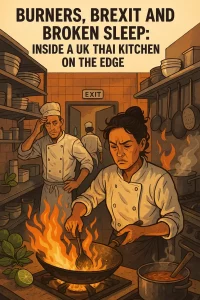
Behind the numbers lies something more intimate: the wear and tear on real people’s bodies and minds. The UK’s ongoing staffing crisis in hospitality has turned many immigrant entrepreneurs into reluctant shape-shifters, constantly morphing between owner, chef, cleaner, bookkeeper, delivery driver, and therapist.
In 2026, many independent business owners report the same pattern:
- They can’t recruit enough staff at wages they can afford.
- They can’t raise prices enough to cover higher wages without scaring off price-sensitive customers.
- They end up filling the gaps themselves – every single day.
The result? Owners who imagined working on the business find themselves trapped working in it. Strategic thinking – menu development, local partnerships, storytelling, marketing – is sacrificed to the emergency of “Who’s doing the evening shift?”
For many immigrant entrepreneurs, the psychological burden is particularly sharp because they are constantly comparing themselves with their predecessors: parents, uncles, older cousins who started small places in the 1980s and eventually bought a house, a second car, maybe even retired early.
The brutal question is: how can someone today, working longer hours with tighter margins and more complicated regulations, justify the same dream of UK business ownership? It’s not just about tired legs; it’s about a growing sense of unfairness, of playing a game whose rules have changed mid-match.
Then there’s the issue of churn. The high turnover of transient staff makes it hard to build the kind of loyal, long-term teams that once formed the backbone of family-run places. Staff disappear after a few months, taking their training and their relationships with regulars with them. The business never quite stabilises. It’s always in a state of becoming, never being.
The Algorithm of Failure: When Apps and Rates Rule the Game
Walk down a British high street at night in 2026 and you’ll see two parallel worlds. Inside the restaurant, a small team, often including the owner, battles through orders and washing-up. Outside, delivery drivers and riders hover like ghosts, phones glowing with the next job from a platform that skims off a hefty cut of every sale.
These platforms – food delivery apps, online booking systems, digital reviews – have become the new gatekeepers of UK business ownership. They bring customers, yes, but on terms that often resemble feudal tribute:
- High commission rates: Delivery platforms may take 25–35% or more per order.
- Algorithmic dependence: Visibility in the app can determine whether you’re busy or empty – but you don’t control the rules.
- Customer data control: Often, you never fully “own” your customer relationships; the platform does.
Meanwhile, physical premises – long seen as the proud proof of UK business ownership – are turning from assets into liabilities. The cost of high-street business rates, rising rents, and property inflation means many owners are paying premium prices to be on a street whose footfall has quietly migrated to screens.
Corporate chains can handle this. They have the reserves to invest in:
- Automated ordering systems
- Centralised kitchens
- Marketing teams and social media experts
- In-house delivery or better-negotiated rates with platforms
By contrast, the typical immigrant-run independent shop is often fighting a multi-front war with far fewer weapons. They can’t afford slick automation, can’t always match the discount offers of chains, and often lack the time or training to play the online visibility game properly. The risk is a quiet digital suffocation: great food, lovely people, almost invisible online.
A Historical Perspective: Britain’s Changing Promise
To understand why this crisis in UK business ownership feels particularly painful for immigrants, we have to revisit a bigger story: Britain’s long history of positioning itself as a place where hard work could transform your life.
From the post-war period through to the early 2000s, the UK (especially its big cities) was a magnet for people from former colonies, from Europe, and beyond. The deal was never formally stated, but well understood:
- You come here.
- You do the jobs others don’t want.
- Your children, or you, will climb – slowly, but surely.
Small businesses were a key part of this social contract. The corner shop, the curry house, the takeaway, the barber, the minicab office – these were more than just services; they were gateways to autonomy, dignity, and intergenerational wealth. They were evidence that Britain, while sometimes cold and suspicious, ultimately rewarded those who persevered.
What we’re seeing in 2026 is the erosion of that contract. Not just because of economics, but because of a deeper shift in how opportunity is distributed. The rewards have drifted upwards and inwards – towards large corporations, asset holders, and those already plugged into finance and technology.
For the new arrivals washing plates and dreaming of their own name above a door, the gap between legend and reality is widening. And when national myths crack, the emotional shock is as real as any bill.
Urban Secrets: Ghost Kitchens, Micro-Units and the New Underground Economy
Yet, as any student of British history knows, when the official routes narrow, unofficial paths open. The story of UK business ownership has always had a touch of the underground and the improvisational – from Victorian costermongers to post-war market traders.
In 2026, some of the most interesting and hopeful developments are happening in the shadows of the old model. The new generation of immigrant entrepreneurs is experimenting with:
- Micro-units: Tiny, tightly designed spaces – sometimes in food courts, container parks, or shared markets – that have far lower fixed costs than a traditional restaurant. The menu is smaller, the concept sharper, the risk more contained.
- Dark kitchens (ghost kitchens): Invisible from the street, these kitchen-only operations exist solely for delivery orders. No dining room, no expensive décor, just a focused cooking space and a brand that lives on apps and social media.
- Shared-equity models: Instead of one owner carrying all the risk, several individuals share the investment and the returns, spreading both burden and control.
These models are not magical solutions. They introduce new vulnerabilities – dependency on apps, online brand management, and the tricky dynamics of shared decision-making. But they show that UK business ownership is evolving, not simply dying.
In a way, this new wave echoes older British urban traditions. Think of the medieval guilds, the hidden courts of London where tradespeople quietly worked, or the sprawling Victorian markets where stallholders rented small patches of space and built reputations over time. Micro-units and dark kitchens are their 21st-century descendants, rearranged for a world run on algorithms.
Cultural Capital as Survival Strategy: Authenticity over Volume
One of the most powerful tools immigrant entrepreneurs bring to UK business ownership isn’t on a balance sheet at all: it’s cultural capital. Stories, recipes, rituals, languages, aesthetics – all the textures of a life lived elsewhere before being transplanted to Britain’s streets.
In an era where huge chains can always undercut on price and convenience, independents need to play a different game. Many are surviving – even thriving – by turning away from high-volume, low-margin models and towards high-margin, niche experiences that lean into authenticity.
Instead of being “just another takeaway”, they become:
- A regional specialist – “only dishes from the north of X country, cooked like my grandmother did.”
- A story-driven space – menus that explain traditions, walls decorated with family photos, curated playlists from back home.
- A hybrid community hub – part café, part cultural centre, part event space for poetry, music, or language exchange.
This approach uses the very thing that once marked immigrants as “other” – their difference – as a premium. People are increasingly willing to pay more for a meal that offers a narrative, a sense of connection, and a feeling that they’ve travelled without leaving the post code.
Of course, this is still wrapped in the hard logic of UK business ownership. Rents must be paid, licenses renewed, and margins protected. But cultural authenticity becomes a kind of shield against the brutal sameness that corporate chains often create.
The New Spellbook: Radical Financial Literacy
If the classic ingredient for success in UK business ownership used to be sheer hard work, in 2026 a different skill set has risen quietly to the top: financial literacy. Not in a vague “be good with money” way, but in a detailed, almost forensic sense.
Today, the most resilient immigrant entrepreneurs tend to be those who treat their accounts not as an afterthought, but as a daily oracle. They know, in near-real time:
- Exactly what it costs to produce each dish, including energy and labour.
- Which menu items carry their business and which are vanity projects.
- How delivery platforms’ commissions affect their actual margin.
- What happens to profits if they adjust opening hours, portion sizes, or suppliers.
They also show a new kind of discipline about debt. Rather than seeing it as an inevitable part of UK business ownership, they approach borrowing like a surgeon approaches a knife: with precision, caution, and a clear exit plan.
Crucially, this kind of financial literacy can be learned. There are free and low-cost resources – from local business support hubs to online courses in basic bookkeeping and cash-flow management. Many councils, for example, host business support services or partner with organisations like the Prince’s Trust or UK government finance support schemes that provide guidance and sometimes grants or loans.
But this requires a mindset shift. In older narratives, the hero of UK business ownership was the tireless worker. In the emerging reality, the hero must also be a quiet analyst, able to look at a spreadsheet and see not just numbers, but a story about what needs to change.
Holistic Survival: Wellbeing, Community and Saying “Enough”
There’s another side to this puzzle that often gets ignored in the rush to talk about overheads and algorithms: the wellness of the people inside these businesses. It’s almost a cliché to say that small-business owners work themselves into illness, but in 2026, the risks are sharper.
Running or aspiring to UK business ownership today doesn’t just demand financial and physical effort; it demands careful attention to mental health, boundaries, and a sense of meaning. Some entrepreneurs are beginning to approach their work in a more holistic way, asking difficult but necessary questions:
- Is the dream I inherited – the classic “own a restaurant” fantasy – still right for me in this era?
- Can I build a smaller, more flexible business that allows time for family, community, or spiritual life?
- What systems can I create to avoid burning out in the first three years?
We’re also seeing the quiet magic of mutual aid. Entrepreneurs sharing staff, swapping advice about ruthless landlords, pooling money for bulk buying, or giving each other days off. This kind of communal resilience has deep roots in British immigrant history – think of informal credit circles or community associations – and it’s resurfacing as a lifeline.
In a sense, the new version of successful UK business ownership might be smaller, more interdependent, and more emotionally honest than the heroic, solitary models of the past. Less “I built this alone”; more “we keep this alive together.”
Is the Path from Kitchen Porter to Owner Dead?
So, has the once-fabled path from washing dishes to running your own place in Britain truly died? Not quite. But it has shape-shifted into something far less romantic and far more technically demanding.
Where once the odds were tough but fair, they are now tough and rigged in subtle ways by costs, platforms, and policies. Where once grit was the central ingredient, it is now necessary but dangerously insufficient without knowledge, networks, and often capital.
Yet history suggests that immigrant entrepreneurship in the UK is stubborn. It adapts. It finds the gaps. The next wave of success stories in UK business ownership may not look like the old corner curry house or family-run chippy. They may be:
- Pop-up concepts that move with festivals and seasons.
- Online-only brands cooked from shared kitchens.
- Hybrid cultural spaces that mix food, art, and storytelling.
- Hyper-local, extremely small operations that stay deliberately modest but deeply sustainable.
The myth of the ladder needs rewriting, not erasing. The new version might say: “Start wherever you can – the sink, the van, the home kitchen – but don’t just watch how people work. Watch how the numbers move, how the digital systems behave, how others share risk. Your path might not lead to a big neon sign on the high street, but to a quieter, smarter form of ownership.”
Conclusion: Rewriting the British Dream of Business Ownership
From the outside, the story of UK business ownership can still look like a simple before-and-after: new immigrant washes plates, hardened entrepreneur signs payroll. But when we look closely at 2026, we find a far more tangled tale.
We’ve seen how:
- The traditional ladder from entry-level work to owning a business has been weakened by collapsing middle management, rising debt risks, and harsh margins.
- An invisible ceiling of overhead – energy volatility, post-Brexit labour costs, and soaring ingredient prices – leaves almost no room for the natural mistakes that once shaped great entrepreneurs.
- The staffing crisis and delivery-platform dominance have turned many independent owners into overworked operators, scrambling to survive against better-funded chains.
- Yet, new blueprints are emerging: micro-units, dark kitchens, shared-equity models, and culturally rich, niche concepts that use authenticity as a shield and a selling point.
- The secret weapons of the future include radical financial literacy, community cooperation, and a more holistic approach to wellbeing and success.
The British Dream for immigrant entrepreneurs is not dead, but it has become more conditional and more complex. The path from scrubbing plates to signing tax returns still exists, but it now passes through spreadsheets, algorithms, cautious borrowing, and deep self-knowledge.
If there is a hopeful message here, it’s this: the spirit that built Britain’s beloved independent cafés, takeaways, and restaurants is still alive. It just needs a new spellbook – one that combines old-world resilience with new-world financial magic. For anyone dreaming of UK business ownership in 2026, the challenge is no longer just to work harder than everyone else, but to understand the game more clearly than ever before – and, where possible, to rewrite the rules together.